Last updated 2026-10-29
Korea's ESS central contract market: how grid-scale storage is procured and paid
The short answer
The ESS central contract market is the only route to a long-term storage contract in Korea today. It is a 15-year availability contract decided on price, grid contribution, safety and contribution to domestic industry, and its terms leave cost, performance and permitting risk with the developer. It is run by the Korea Power Exchange as an auction for new standalone battery storage. Winners sign a 15-year contract. Jeju also offers 25 years (two cycles a day). Winners are paid a fixed price per unit of available capacity, adjusted for how well they follow dispatch instructions. On the mainland the project has no wholesale market exposure. It does not pay for charging or earn from discharging, and the exchange decides when it runs. The market has grown from 65 MW in Jeju in 2023 to 1,180 MW in the 2026 round, for which proposals are due at 18:00 on 4 November and final bids close at 15:00 on 11 November 2026.
Key numbers
| Item | Figure | Status | Source date |
|---|---|---|---|
| 2026 volume | Mainland 1,100 MW / 6,600 MWh; Jeju 80 MW / 480 MWh | Notice | 22 September 2026 |
| Duration | Six hours at maximum discharge | Notice | 22 September 2026 |
| Contract term | Mainland 15 years; Jeju 15 years (trading) or 25 years (two cycles a day) | Notice | 22 September 2026 |
| Payment basis | Contract price × available capacity × performance rate, calculated daily and settled monthly | Notice | 22 September 2026 |
| Scoring | Price 50%, non-price 50%; below 40% on grid contribution, industry and economy, or fire and equipment safety is excluded from price evaluation (Jeju: industry and economy, and fire and equipment safety only) | Notice | 22 September 2026 |
| Ceiling price | Set from a levelised cost of storage; not published | Notice | 22 September 2026 |
| Permit deadline | Generation permit within nine months of award, or the award is cancelled | Notice | 22 September 2026 |
| Completion deadline | February 2029 | Notice | 22 September 2026 |
| Proposals / bids | Proposals due 4 November; bids close 11 November | Notice | 22 September 2026 |
| Average winning prices | Not published for any round | — | — |
What it means for investors and VPP operators
- On the mainland, the return is fixed by the bid. It is the bid price, less any deductions. Price spreads, trading skill and wholesale market reform do not change it. The decision to bid is a decision about cost: whether the project can be built and run for 15 years at the price bid, with no indexation.
- The risk sits in the downside clauses. Contract prices can be reduced, never raised: for equity below 15% at completion, warranted capacity retention or efficiency below the values bid, a lower credit rating on transfer, or missed equipment requirements. A project that misses its permit deadline loses its award. Lender exposure sits in these clauses.
- Volume favours developers with grid sites and balance sheets. Bids are limited to listed substations, grid contribution carries 23 of the non-price points, and the financial tests favour sponsors that can hold 15% equity through completion. The 2026 round is roughly twice the size of each 2025 round, so more capacity is available to win, on terms that have changed only in detail.
- Jeju's 15-year option is the one place where trading skill pays. Every won below the monthly benchmark is kept; three-quarters of revenue between one and three times the benchmark is returned. An optimiser earns most for a project in its weak months and at higher bid prices: a higher bid raises both the fixed part and the benchmark, so more trading revenue falls below the benchmark and is kept in full rather than returned in the clawback band. Total revenue rises, but the price score falls and the chance of winning shrinks, so the bid and the trading strategy have to be set together.
- VPP operators have no role in the mainland contract. Mainland central contract storage is dispatched by the exchange. The VPP opportunity in storage sits in the distribution-grid programmes, where a registered VPP operator must lead each application; our special report covers these programmes.
- Uncontracted storage remains the alternative, at a disadvantage. A battery outside the contract earns trading revenue that, on our calculation, was below Jeju's in every quarter of 2025 and 2026, with the widest gap in the first half of the year. On our reading, until a mainland bidding market opens (government plan for 2027–2028, no confirmed date), the contract is the stronger case for most investors.
How the market is set up
The market rests on exchange rules approved by the minister, so its terms can change from round to round without legislation (our reading). No statute establishes the market itself; it is created entirely under chapter 15 of the Korea Power Exchange's market operation rules, the "low-carbon central contract market", added in December 2022. The rules are made by the exchange under Article 43 of the Electricity Business Act and approved by the Minister of Climate, Energy and Environment after review by the Electricity Regulatory Commission. Chapter 15 defines the market as one in which the exchange signs long-term contracts for capacity and ancillary services from low-carbon resources, including storage. A central contract market committee opens each round and sets the resource type, volume, reference price and eligibility. Volume is linked to the national basic plan for electricity supply and demand; the notice cites the 2028 storage requirement under the 11th plan (the bidder briefing says 2028–2029).
How each round works
The rules favour sponsors with sites at listed substations and the balance sheet to hold 15% equity through completion. The nine-month permit deadline is the main early risk.
Eligibility. Only new, standalone storage may bid. Facilities that have traded under the RPS or another scheme, received a subsidy, or would participate in two schemes at once are excluded, as are mixed chemistries. Lithium-ion systems need national safety certification. Sponsors need paid-in capital of at least 1% of total project cost, an equity ratio of at least 15% at completion and a credit rating of B- or above. Projects must connect at substations on a published list of grid-constrained substations and substations where storage is needed. The list refers to grid-constrained substations as managed by Korea Electric Power Corporation (KEPCO) at the time of the notice, so on our reading Honam substations whose designation was lifted on 1 October remain eligible.
Evaluation. Price and non-price criteria each carry 50 points. The price score compares each bid with the lowest bid, in KRW per kW of available capacity per hour. Non-price criteria cover grid contribution, fire and equipment safety, technical performance, and contribution to domestic industry and the economy, including the origin of key components. On the mainland, grid contribution (23 points) is assessed qualitatively from curtailment levels, connection limits and KEPCO's reinforcement plans; in Jeju it is scored by the renewable capacity already connected at the substation. A project scoring below 40% of the points on grid contribution, on contribution to industry and the economy, or on fire and equipment safety is excluded from price evaluation (Jeju: industry and economy, and fire and equipment safety only). Awards run in order of score up to 105% of the announced volume on the mainland and 100% in Jeju. The ceiling price is set from a standard levelised cost of storage and is not published. If bids cover half the volume or less, the round may be re-run. If eligible bids are less than 1.15 times the announced volume, the exchange may reduce the volume awarded so that the ratio reaches 1.15 to 1.
Equipment. The 2026 round requires six hours of continuous discharge at full output, 383 cycles a year on the mainland, 70% capacity retention over the contract, a minimum 65% round-trip efficiency and grid-forming capability in line with the market rules and KEPCO's connection standards. Adding design capacity beyond the bid is not allowed. The cycle figure is an equipment requirement; it is not a guarantee of how often the project will be dispatched.
Payment. The mainland project is paid the contract price multiplied by its available capacity (storage capacity in kWh divided by six hours) and by a performance rate, calculated daily and settled monthly. The performance rate falls when charging or discharging instructions are not met. Charging costs and discharging revenue are not settled to the project. The exchange describes this as total investment cost recovery.
Obligations and penalties. A performance bond of 10% of a year's bid value is held from contract signature to commercial operation. Delays are penalised in three bands. A project that does not reach commercial operation within two years of the end of its preparation period, or does not register as a trader six months before trading starts, is cancelled. At the end of the contract, retired batteries must be disposed of in Korea. Contract prices can be reduced but never raised above the bid: under the notice's penalty formula, any missed non-price score is deducted by recalculating the contract price downward to what the bid would have needed to be. For warranted capacity retention and round-trip efficiency, the original price is restored if the yearly test value returns to the bid level; for failing to meet the mandatory 15% equity ratio at completion, the resulting price reduction is permanent with no reversal over the 15-year term.
How the market has grown
Since 2025, the rounds have moved weight from price towards grid contribution and safety, which favours well-sited projects over the lowest-cost bid.
| Round | Mainland | Jeju | Duration | Result |
|---|---|---|---|---|
| 2023 | — | 65 MW / 260 MWh | Four hours | 68 MW awarded at three sites |
| 2025, first | 500 MW / 3,000 MWh | 40 MW / 240 MWh | Six hours | 563 MW awarded at eight sites (final) |
| 2025, second | 500 MW / 3,000 MWh | 40 MW / 240 MWh | Six hours | 565 MW at seven sites (preferred bidders) |
| 2026 | 1,100 MW / 6,600 MWh | 80 MW / 480 MWh | Six hours | Bids close 11 November; preferred bidders expected in November |
| 11th Basic Plan, 2026–2029 | 2.1 GW planned (2026–2029) | 0.12 GW planned (2026–2028) | — | 2.22 GW in all, covered by the 2025–2026 rounds (2,260 MW, our calculation); the next round depends on the 12th Basic Plan |
Terms have moved with each round. The price weighting fell from 60% to 50% in the second 2025 round, and fire safety gained weight. The 2026 round lengthened the permit deadline from six to nine months, tightened the delay bands, made grid-forming capability explicit and replaced the mainland's ranking by curtailment with a qualitative grid score. Most capacity awarded on the mainland so far is sited in the south-west, where curtailment is highest.
Jeju's 15-year option: where trading skill changes the return
The 15-year option is the only contract in this market in which trading changes the return. It favours owners with a strong trading operator, but its upside is narrow. The 15-year trading design was introduced in the second 2025 round; in 2026 both options compete in one ranking. The 25-year option, new in 2026, pays 100% of the bid price and does not allow trading; the exchange introduced it to bring in long-life storage that absorbs night-time wind curtailment. It requires at least 730 cycles a year and 18,250 cycles over 25 years, a level that, on our reading, favours long-life chemistries such as flow batteries; the notice sets requirements for both lithium-ion and flow batteries. On our reading, the 15-year option is the one that matters for lithium-ion.
How the payment works
The 15-year option splits the bid price into a fixed part and a market part.
- Fixed part. The project is paid 60% of its bid price per unit of available capacity, adjusted by the performance rate, exactly as on the mainland.
- Market part. The project trades in Jeju's day-ahead and real-time markets. It submits its own charging and discharging schedule, up to six hours each a day, and energy is settled twice: day-ahead volumes at the day-ahead price and real-time deviations at the real-time price. The exchange can still set hours in which discharging is not allowed and issue separate dispatch instructions when the system needs them.
- Benchmark. Each month, the project's net market revenue (energy settlement plus ancillary service payments) is compared with an expected-revenue benchmark equal to 40% of the bid price × 24 hours × the days in the month × awarded capacity in kW. The notice contains no payment to make up a month below the benchmark, and states that 60% of total project cost is not guaranteed.
Monthly market revenue is then kept in three bands:
| Monthly market revenue | Share kept by the project |
|---|---|
| Up to the benchmark | 100% |
| Between one and three times the benchmark | 25% (75% returned to the system) |
| Above three times the benchmark | 100% of the amount above three times |
The exchange calls the method "net investment cost recovery plus trading" and describes it as a pilot market mechanism for Jeju, modelled on the long-term energy service agreements used in New South Wales. On our reading, it works like a net cost-of-new-entry (net CONE) design, a concept from US capacity markets: the fixed payment covers the part of new-entry cost the market is not expected to cover.
A worked example
Our illustration, not from the notice: a 40 MW / 240 MWh project bidding KRW 30 per kW of available capacity per hour, in a 30-day month, at a performance rate of 100%.
| Amount (KRW m) | |
|---|---|
| Fixed part: 60% × 30 × 24 hours × 40,000 kW × 30 days | 518 |
| Benchmark: 40% × 30 × 24 hours × 40,000 kW × 30 days | 346 |
| Market revenue 200 → kept | 200 (all below the benchmark) |
| Market revenue 600 → kept | 346 + 25% × 254 = 409 |
| Market revenue 1,200 → kept | 346 + 25% × 691 + 163 = 682 |
Tripling market revenue from 200 to 600 adds KRW 209m; doubling it again to 1,200 adds a further KRW 273m. The bands flatten the return in the middle and open it again at the top.
Where an optimiser adds value, and where it does not
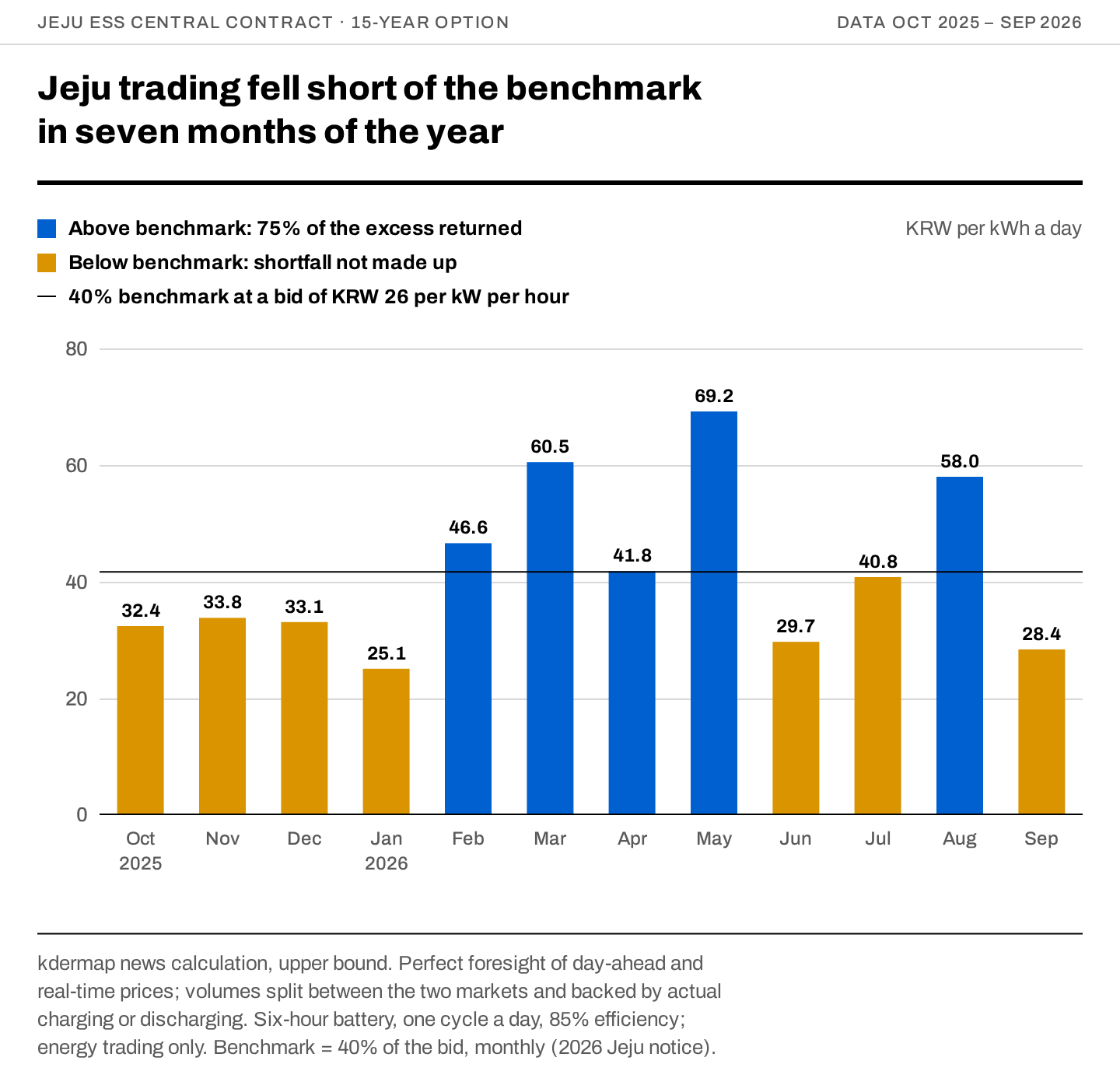
- Weak months are worth the most. Every won earned below the benchmark is kept in full. Because the benchmark is assessed month by month and Jeju spreads are concentrated in spring, the months where better trading pays most are the summer and autumn months when spreads are thin.
- In strong months, most extra revenue is returned. In months above the benchmark, three-quarters of any extra revenue is returned until revenue reaches three times the benchmark. For bids near the level at which annual revenue meets the benchmark, the spring months, when Jeju spreads are widest, are the months most likely to fall in this band.
- Higher bids raise total revenue but lower the chance of winning. The fixed part and the benchmark both rise with the bid price, and more trading revenue stays below the benchmark where it is kept in full, so clawback shrinks and the project keeps more. On our calculation, Jeju day-ahead and real-time trading from October 2025 to September 2026 covers the benchmark, on an annual average, only for bids up to about KRW 26 per kW per hour (perfect foresight of both day-ahead and real-time prices, volumes split between the two markets and backed by actual charging or discharging; six-hour battery, one cycle a day, 85% efficiency; energy trading only; an upper bound). Above that level, the market portion falls short of the benchmark in more months, but the higher fixed part and reduced clawback still lift total revenue. The constraint is the price score: the 50 price points compare each bid with the lowest, so a higher bid is harder to win.
- Day-ahead to real-time spreads and ancillary services count. Both are part of market revenue under the benchmark. On our calculation, the real-time market, which the mainland does not have, is where Jeju's largest spreads occur.
- The limits are set by the exchange. Discharge-prohibited hours, separate dispatch instructions and the performance rate on the fixed part all constrain the schedule. The optimiser works inside them.
The design rewards consistent trading through the year more than peak capture in spring. Our special report works through one year of Jeju trading for a 100 MW project.
Public documents give no basis for extending this design to the mainland. The 2026 briefing lists the mainland method as total investment cost recovery, unchanged from 2025.
Contracted or wholesale: who benefits
Today, procurement favours the contracted model, which carries the volume, and the market reforms that would strengthen the wholesale case are government plans without fixed dates. Korean storage now has two business models, with Jeju's 15-year option between them. The contracted model sells capacity to the exchange for a fixed price and hands over dispatch. The wholesale model keeps control of the battery and earns from price spreads and capacity payments, with all market risk on the owner. Procurement design and market reform decide which model wins, and for whom.
| Central contract (mainland) | Jeju 15-year option | Wholesale (uncontracted) | |
|---|---|---|---|
| Revenue | Fixed price × availability × performance | 60% fixed, plus market revenue kept in three bands | Price spreads and capacity payments |
| Who schedules | Korea Power Exchange | Owner, within exchange limits | Owner or its VPP operator |
| Price risk | System | Shared | Owner |
| Main risks to the owner | Cost overrun, performance deductions, permit and completion deadlines | As mainland, plus months below the benchmark | Thin mainland spreads, curtailment, rule changes |
| Who it suits | Developers with grid sites, sponsors with strong balance sheets, lenders seeking availability income | Developers paired with a strong trading operator | Operators with trading capability, once a mainland bidding market or reserve market opens |
Not yet decided
- Ceiling prices and average winning prices for any round.
- Results of the 2026 round, expected in November 2026.
- Whether the Jeju 15-year trading design will be evaluated or extended.
- The procurement method for transmission-side storage in the 2027 budget proposal, which public documents do not set out.
- Volumes for rounds after 2026, which depend on the next basic plan.
Sources
- Korea Power Exchange, 2026 mainland ESS central contract market notice · 2026-09-22
- Korea Power Exchange, 2026 Jeju ESS central contract market notice · 2026-09-22
- Korea Power Exchange, 2026 ESS central contract market bidder briefing · 2026-09-30
- Korea Power Exchange, second 2025 ESS central contract market bidder briefing (session 1), p.19 (Jeju design modelled on New South Wales LTESA) · 2025-11-27
- Korea Power Exchange, market operation rules, chapter 15 (low-carbon central contract market) · 2026-07-24
- Electricity Business Act, Article 43 (market operation rules) · 2026-09-18
- kdermap news special report: Korea Storage and VPP Outlook 2026–2030 · 2026-10-15
Related cards
- Korea's largest storage tender to date fixes unindexed 15-year prices
- Korea Power Exchange Opens 3rd ESS Central Contract Market
- Korea Initiates Public ESS Procurements Exceeding 7GWh, Valued Over 2 Trillion Won
- Korea announces second round of AI-enabled ESS subsidy for grid-constrained distribution lines