Last updated 2026-10-21
Korea Storage and VPP Outlook 2026–2030: Grid Reform, Procurement Pipeline and Contract Terms
Summary
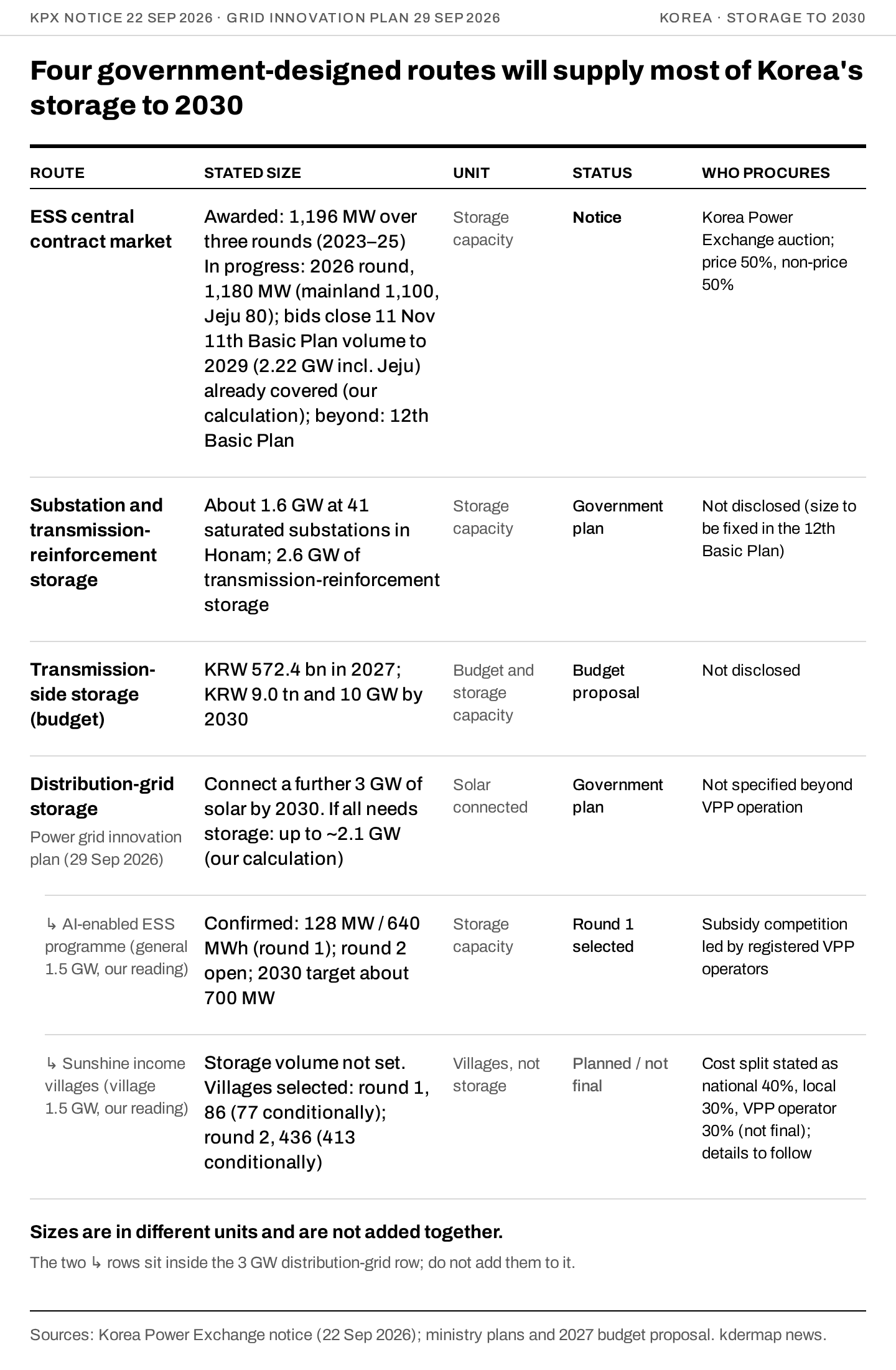
Most new storage in Korea to 2030 will come from four government-designed routes: the central contract market, substation and transmission-reinforcement storage, transmission-side storage in the 2027 budget proposal, and distribution-grid storage (including sunshine income village storage). The wholesale market alone will add little. New grid rules decide who can connect.
On the mainland, the central contract market is the only model that makes storage profitable until a Jeju-style bidding market opens (planned for 2027–2028, no confirmed date). Lenders can finance against it, but the contract leaves construction cost, performance and permitting risk with the developer. Distribution-grid and village storage earn from the wholesale market, where mainland revenue was below Jeju's in every quarter of 2025 and 2026 (our calculation). The substation and transmission-side routes cannot be assessed until the government says how they will be procured. VPP operators gain a role that other projects must go through to connect, but how that role will be paid is not yet set.
Our recommendation differs between the transmission grid and the distribution grid. On the transmission grid, the central contract market is the only long-term contract until the government decides how its planned transmission-side storage programme will be procured. Either way, sites that can connect to the grid are the constraint, so investors should secure sites first. On the distribution grid, investors should pair storage with a VPP operator and win government programmes now. On our reading, this business can expand into private projects once the mainland bidding market, regional prices and rules letting export-limited connection rest on a contract with grid-connected storage are set.
Our verdict by investor type
- Storage developers and operators: central contracts go to bidders that build construction and permitting risk into their price. Distribution-grid programmes pay part of the installation cost and let storage trade in the wholesale market, but give no fixed revenue. Their main value is a position ahead of market reform.
- VPP operators: distribution-grid storage gives VPP operators a role that other projects must go through to connect or receive support. A service market around non-firm access may follow, but the plan does not describe one (our reading). In the renewable contract market, the draft regulations let only designated renewable energy service companies (ReSCOs) aggregate projects of 500 kW or below, so other VPP operators would need designation or a ReSCO partner.
- Infrastructure equity: the fixed revenue that lenders will finance is in the central contract market. Awards depend on price, grid contribution, safety and contribution to domestic industry. Cost of capital decides who can bid lowest, so the realistic role for financial investors is as capital partner to developers that can win. Jeju has two options. The 25-year option pays the full bid price and, on our reading, suits long-life chemistries. The 15-year option pays 60% of the bid price and leaves the rest to trading. It is the realistic route for lithium-ion, but three-quarters of revenue between one and three times the benchmark is returned.
- Project finance lenders: central contract payments depend on availability, not on wholesale prices. But contract prices can be cut and never raised, and a project that misses its permit deadline loses its award.
Grid access will increasingly depend on controlling output
Honam projects that held a permit on 30 September 2026 gain first. Later entrants in grid-constrained areas increasingly connect through routes that require output control, which makes storage and VPP control a condition of access. The power grid innovation plan of 29 September 2026 aims to connect more than 100 GW of renewables by 2030, mostly by making more use of the existing grid rather than waiting for new lines.
The plan changes the connection rules in four ways that matter for storage and VPPs.
| Route | What changes | Status |
|---|---|---|
| Non-firm access | Up to 16 MW per distribution line (from 14 MW) and 60 MW per substation transformer (from 50 MW); these projects are curtailed first | Government plan; distribution lines from January 2027 |
| Self-managed (export-limited) connection | Connection based on export limit rather than rated capacity, with exports kept within the limit by storage or other means; the plan expects distribution lines to host two to three times (up to six times) more installed solar, provided storage is economic | Government plan; pilots from September 2026, rules in first half of 2027 |
| Distribution-grid storage | Storage on grid-constrained lines to connect a further 3 GW of solar by 2030, installed and operated by VPPs | Government plan; round 2 subsidy open 2–20 November 2026 |
| Connection by auction | From January 2027, auction winners receive a fixed-price contract together with a grid connection right | Government plan; Korea Electric Power Corporation (KEPCO) rules to be amended by November 2026 |
In Honam (south-west Korea), the grid-constrained designation was lifted at 164 substations on 1 October 2026. Projects that held a generation permit on 30 September apply first (transmission-level applications close 30 October; distribution-level applications remain open); new applicants follow from January 2027. Separately, about 9 GW of connection rights held by projects that were not progressing has been recovered since 2024. Under the plan, future projects would lose their place if environmental assessment or a fixed-price award is not secured by set deadlines.
From 16 December 2026, when the amended Distributed Energy Act and Electricity Business Act take effect, public-interest renewable projects of 1 MW or less, such as projects by residents near national transmission lines or by cooperatives in growth-promotion areas, will receive priority grid connection (transmission and distribution). Which other community projects qualify is left to a presidential decree that has not been issued.
The result is two kinds of access. Permits held by 30 September 2026 are a scarce asset in Honam. At saturated substations, later entrants connect through routes that require output control until reinforcement arrives in 2028–2030: non-firm access, export limits backed by storage, or connection as a VPP resource. Export-limited connection is the clearest new source of demand for storage co-located with solar, although whether such storage may charge from the grid is not set out in public documents (rules due in the first half of 2027).
The pipeline to 2030 is government-designed
Developers that can bid in the central contract market gain now. The larger transmission-side and distribution-grid figures cannot yet be counted as private opportunity, because each is in a different unit and at a different stage.
| Route | Stated size | Unit | Status | Who procures, and how |
|---|---|---|---|---|
| ESS central contract market | Awarded so far: 1,196 MW over three rounds (2023 Jeju 68 MW; 2025 563 MW final and 565 MW preferred bidders). In progress: 2026 round, mainland 1,100 MW / 6,600 MWh and Jeju 80 MW / 480 MWh, bids close 11 November. The 11th Basic Plan's volume (2.22 GW: mainland 2.1 GW for 2026–2029, Jeju 0.12 GW for 2026–2028) is already covered by the 2025–2026 rounds, 2,260 MW in all (our calculation); volume beyond that depends on the 12th Basic Plan | Storage capacity | Notice, 22 September 2026 | Korea Power Exchange auction; price 50%, non-price 50% |
| Substation and transmission-reinforcement storage | About 1.6 GW at 41 saturated substations in Honam; 2.6 GW of transmission-reinforcement storage | Storage capacity | Government plan; size to be fixed in the 12th Basic Plan for Electricity Supply and Demand | Not disclosed |
| Transmission-side storage (budget) | KRW 572.4 bn in 2027; KRW 9.0 tn and 10 GW by 2030 | Budget and storage capacity | 2027 budget proposal | Not disclosed |
| Distribution-grid storage (power grid innovation plan, 29 September 2026) | Connect a further 3 GW of solar by 2030 (1.5 GW general, 1.5 GW for sunshine income villages). If all of it needed storage, up to about 2.1 GW / 10.5 GWh (our calculation) | Solar connected | Government plan | Not specified beyond VPP operation |
| ↳ AI-enabled ESS programme (on our reading, within the general 1.5 GW) | Confirmed: 128 MW / 640 MWh on 32 lines (round 1). Round 2 open for 34 lines. 2030 target about 700 MW (10 July 2026 release; a November 2025 plan said about 340 MW) | Storage capacity | Round 1 selected; round 2 notice | Subsidy competition led by registered VPP operators |
| ↳ Sunshine income village storage (on our reading, the village 1.5 GW) | Storage volume not set. Storage is for villages in grid-constrained areas. Villages selected: round 1, 86 of 129 (9 outright, 77 conditionally, 58 of them on grid grounds as reported); round 2, 436 of 608 (23 outright, 413 conditionally; grid count not published) | Villages, not storage | Planned in the round 3 village notice; details to follow | Cost split stated as national 40%, local 30%, VPP operator 30% (not final) |
Distribution-grid storage is one route with two programmes under it. The power grid innovation plan sets the total as 3 GW of solar to connect, split into 1.5 GW general and 1.5 GW for sunshine income villages. On our reading, the AI-enabled ESS programme sits within the general half and the village storage programme is the village half, though no government document links either directly. Only the AI-enabled programme has a confirmed storage volume so far. The two sub-rows are part of the 3 GW row, so do not add them to it.
Three points follow from the table.
First, the central contract market is the only route with an announced auction, published terms and a track record. Its volume has grown from 65 MW in Jeju in 2023, to two rounds of 540 MW each in 2025, to 1,180 MW in a single round in 2026. Average winning prices have not been published. The 11th Basic Plan for Electricity Supply and Demand (March 2025) set 2.22 GW of batteries and other storage to be procured through this market: 2.1 GW on the mainland for 2026–2029 and 0.12 GW in Jeju for 2026–2028. On our calculation, the 2025–2026 rounds (540 MW, 540 MW and 1,180 MW, 2,260 MW in all) already cover it. The plan sets no selection volume beyond 2029, and for Jeju it leaves later years to the next plan. Its mainland storage requirement keeps rising, from 2.1 GW in 2029 to 4.0 GW in 2030, 7.6 GW in 2031 and 22.5 GW in 2038, and no new pumped hydro can enter before 2035. The size of the next round therefore depends on the 12th Basic Plan, and on our reading it is likely to be larger.
Second, the largest figure is transmission-side storage in the 2027 budget proposal: KRW 572.4 bn in 2027, rising to KRW 9.0 tn and 10 GW by 2030. On our calculation, 10 GW is about nine times the mainland volume of the 2026 central contract round. Unlike the central contract market, which is paid for through electricity market settlement, this line is funded from the government budget; the budget groups it with power quality stabilisation equipment and virtual power line storage as grid stabilisation investment. The procurement method is not yet published. Who benefits, and how they get in, depends on whether KEPCO invests directly and runs the storage as grid assets, private investors own it under central dispatch by the exchange through a central contract auction, or private investors own it and schedule it themselves. Current central contract notices exclude subsidised facilities, so the auction route would need a rule change.
Third, the 3 GW distribution-grid figure is solar to be connected, not storage to be built, but the ministry's own figures give a storage equivalent. The AI-enabled ESS programme plans about 700 MW of storage to connect about 1 GW of solar, and its first round selected 128 MW / 640 MWh to connect 182.4 MW. At that ratio, about 0.7 MW of five-hour storage per MW of solar, 3 GW of solar implies up to about 2.1 GW / 10.5 GWh of storage on our calculation. This is the full potential: some solar may connect with output curtailment alone, without storage, and the sunshine income village half may follow a different design. The two sub-rows in the table sit inside this 3 GW and should not be added to it.
Only the central contract market offers a bankable contract, and it leaves risk with the developer
The central contract market is becoming the main bankable route for mainland storage, but its terms put cost, performance and permitting risk on the developer.
The mainland central contract is a 15-year availability contract. The project receives no wholesale revenue: charging costs and discharging revenue are not settled. Instead it is paid the contract price multiplied by its available capacity (storage capacity in kWh divided by six hours) and by its performance rate, calculated daily and settled monthly. The performance rate falls when dispatch instructions from the Korea Power Exchange are not met. Price risk therefore passes almost entirely to the system.
What stays with the developer:
- Cost: the bid price is fixed for 15 years with no indexation, against a ceiling that is not published.
- Price adjustments: the contract price is reduced if equity falls below 15% at completion, if warranted capacity retention or round-trip efficiency falls short of the values bid, if credit rating falls on transfer, or if equipment requirements are not met. Contract prices can be reduced but never raised above the bid. For warranted capacity retention and round-trip efficiency, the original price is restored if the yearly test value returns to the bid level; an equity shortfall at completion has no such reversal.
- Permitting: a winning project that does not obtain its generation permit within nine months loses its award.
- After year 15: there is no payment.
- Entry: non-price criteria carry half the score. They include grid contribution, fire and equipment safety, and contribution to domestic industry and the economy, including the origin of key components. A project scoring below 40% of the points on any of these three is excluded from price evaluation (in Jeju, the threshold applies to safety and to industry and the economy only).
The rated 383 cycles a year is an equipment requirement, not a volume obligation; dispatch is decided by the Korea Power Exchange.
The other routes compare as follows.
| Route | Fixed income | Market income | Who carries price risk | Term | Performance exposure |
|---|---|---|---|---|---|
| Mainland central contract | Availability payment × performance rate | None | System | 15 years | Contract prices can be reduced, never raised; payment reduced for missed dispatch |
| Jeju central contract, 15-year | 60% of bid price × performance rate | Trading revenue, shared in three bands | Shared | 15 years | As above, plus trading shortfall |
| Jeju central contract, 25-year | 100% of bid price × performance rate | None (trading not allowed) | System | 25 years | As mainland; rated for two cycles a day |
| Distribution-grid storage programme | Up to half of eligible capex as subsidy | Capacity payments and trading, wholesale or PPA | Owner | 20-year operation | Resource-recruitment and operating obligations |
| Uncontracted mainland storage | None | Wholesale market | Owner | — | — |
The distribution-grid programme lowers upfront cost but leaves all revenue risk with the owner, on lines that hold at most 4 MW / 20 MWh each. The transmission-side programme cannot be assessed until its procurement method is published.
Jeju's 15-year option: a contract that leaves part of the return to the market
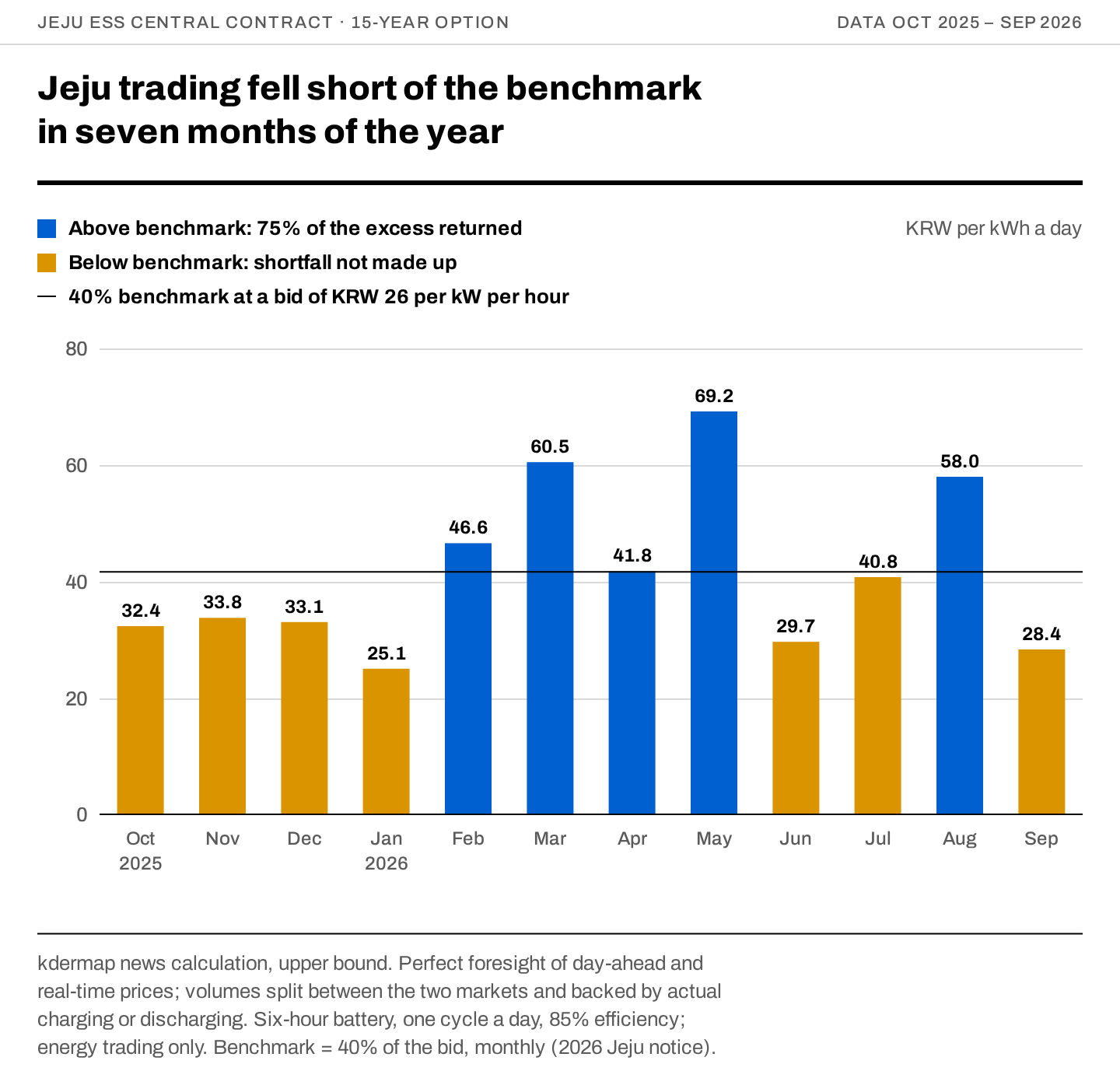
For lithium-ion storage in Jeju, the 15-year option is the realistic central contract route. The bid sets both the fixed payment, which lenders can finance against, and the share the market must supply. On our calculation, Jeju trading from October 2025 to September 2026 would have covered that share only for bids up to about KRW 26 per kW per hour, and even at that bid the project would have recovered about 96% of it, because weak months are not topped up and three-quarters of the excess in strong months is returned.
The 25-year option pays 100% of the bid price and does not allow trading. It requires at least 730 cycles a year and 18,250 cycles over 25 years, a level that, on our reading, favours long-life chemistries such as flow batteries; the notice sets requirements for both lithium-ion and flow batteries. The Korea Power Exchange created it to bring in long-life storage that absorbs night-time wind curtailment, which rises sharply when the HVDC link to the mainland is down (bidder briefing). Both options compete in one ranking.
The 15-year option, introduced in the second 2025 round, pays 60% of the bid price as an availability payment and lets the project trade. Monthly trading revenue is compared with an expected-revenue benchmark equal to 40% of the bid price × 24 hours × the days in the month × awarded capacity in kW. Revenue up to the benchmark is kept in full. Revenue between one and three times the benchmark is kept at 25%, with 75% returned. Revenue above three times the benchmark is kept in full. The notice states that 60% of total project cost is not guaranteed. The Korea Power Exchange calls the method "net investment cost recovery plus trading" and describes it as a pilot market mechanism for Jeju, modelled on the long-term energy service agreements used in New South Wales. On our reading, it works like a net cost-of-new-entry (net CONE) design, a concept from US capacity markets: the fixed payment covers part of the cost of new entry, and the market is expected to cover the rest.
The bid price sets both parts at once. A higher bid raises the fixed payment, but it also raises the market benchmark and lowers the chance of winning an auction in which price carries 50% of the score. Jeju trading revenue does not depend on the bid.
On our calculation, a six-hour battery cycling once a day in Jeju's day-ahead and real-time markets would have earned about KRW 41.7 per kWh of storage per day from October 2025 to September 2026, or about KRW 91,000 per kW of awarded capacity over the year. That covers the 40% benchmark, on an annual average, for bids up to about KRW 26 per kW per hour. The project recovers its full bid only at bids up to about KRW 22.
For a 100 MW / 600 MWh project bidding at that level, the year would have looked like this:
| KRW bn a year | |
|---|---|
| Bid price × awarded capacity × hours in the year | 22.8 |
| Fixed payment (60%) | 13.7 |
| Market benchmark (40%) | 9.1 |
| Market revenue earned | 9.1 |
| Market revenue kept after the monthly bands | 8.2 |
| Total income | 21.9 (96% of the bid) |
The market earned its share over the year but not month by month. Revenue was below the benchmark in seven months, October 2025 to January 2026, June, July and September 2026, and nothing makes up those months. From February to May and in August, three-quarters of the revenue above the benchmark was returned. A project that bids higher gains fixed, bankable revenue but widens this gap and lowers its chance of winning.
How these figures are built: perfect foresight of both day-ahead and real-time prices; volumes are split between the two markets, and every commitment is backed by actual charging or discharging. Six-hour battery, one cycle a day, 85% efficiency. Energy trading only; ancillary service revenue, which counts towards the benchmark, is excluded. This is an upper bound: real trading would earn less, and ancillary revenue would add to it. Actual bid prices have not been published.
There is no public basis for extending this design to the mainland. The 2026 briefing lists the mainland settlement method as total investment cost recovery, unchanged from 2025.
Mainland market revenue is thin, and the gap with Jeju is seasonal
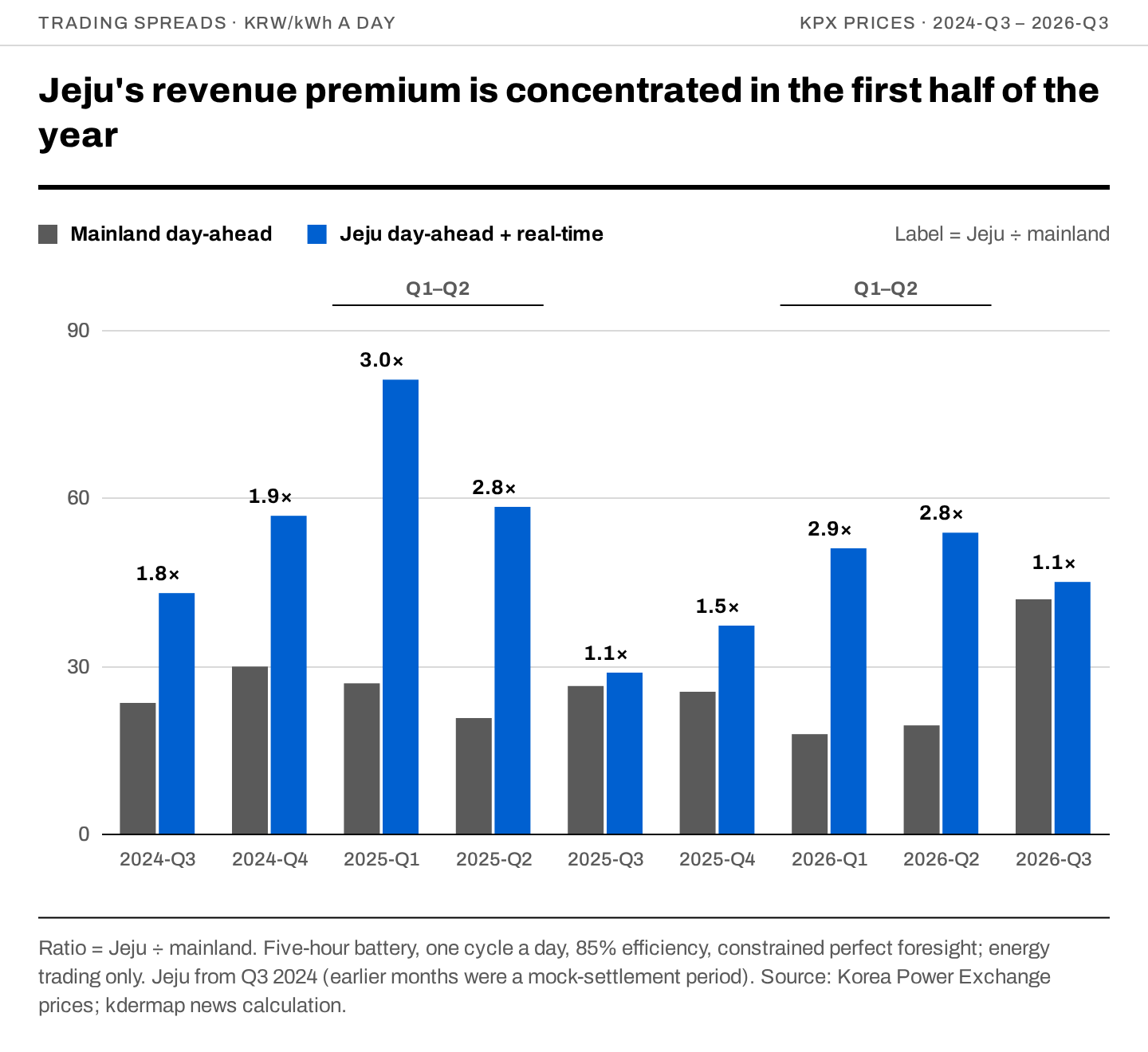
Uncontracted mainland storage earns less than Jeju storage: on our calculation, mainland trading revenue is lower than Jeju's in every quarter, and the difference is concentrated in the first half of the year. A Jeju-style market would add a real-time spread on the mainland, but without locational prices a single mainland price blends Honam's spring solar surplus with demand elsewhere, so on our reading it is unlikely to close the annual gap fully.
Over the 12 months to September 2026, a five-hour battery cycling once a day with perfect foresight would have earned KRW 26.2 per kWh of storage capacity per day on the mainland day-ahead market, against KRW 46.7 in Jeju trading day-ahead and real-time together. This comparison uses a five-hour battery to match distribution-grid installations. For a 4 MW / 20 MWh installation on a distribution line, our estimate of annual revenue is about KRW 0.47 bn on the mainland under current capacity payment rules (KRW 0.19 bn trading and KRW 0.28 bn capacity payments), or about KRW 0.52 bn if Jeju's capacity formula were extended to the mainland, against about KRW 0.87 bn in Jeju (KRW 0.34 bn and KRW 0.53 bn). The mainland figure is about 54–60% of Jeju's.
The quarterly figures show where the gap comes from. In trading revenue alone (before capacity payments and network charges), Jeju earned 2.8 to 3.0 times the mainland figure in the first and second quarters of 2025 and 2026. In the third and fourth quarters of 2024 and 2025, and the third quarter of 2026, the ratio was between 1.1 and 1.9 times, with the low point in the third quarters of 2025 and 2026. Jeju's premium is concentrated in the first half of the year, which includes Jeju's spring season of negative prices and solar curtailment. Jeju's own spring revenue is also falling: KRW 81.1 per kWh of storage capacity per day in the first quarter of 2025, KRW 51.0 in the first quarter of 2026.
The rule changes that could close the gap have not been adopted: a renewable bidding market on the mainland (a mainland version of Jeju's market, in which renewable generators and storage bid prices into day-ahead and real-time markets; government plan for 2027–2028 in the government's implementation plan III for 15 flagship projects (joint ministries, 26 November 2025), no confirmed date), a reserve market under review from 2029, and regional wholesale prices. The Korea Power Exchange has proposed regional prices, and its Rules Revision Committee is reviewing the proposal against opposition from private coal generators. The exchange's simulation for July 2025 to June 2026 (simulated values, not actual prices or a forecast) splits the capital region from the rest of the mainland in 31% of hours, always with lower prices outside the capital region and mostly at midday: in the hour to 1 pm the average was KRW 62.5 per kWh outside the capital region against KRW 102.7 inside it. On our reading, that would give storage outside the capital region cheaper midday charging, while solar in the same regions would sell for less. The mainland has no real-time market today, which removes the day-ahead to real-time spread that adds most to Jeju revenue.
How the estimate is built: trading spreads are calculated from Korea Power Exchange prices with constrained perfect foresight (five hours, one cycle a day, 85% efficiency). Capacity payments use the 2026/27 mainland reference capacity price for the newest vintage, KRW 13.60 per kW per hour (published as KRW/kWh) (Jeju figures use Jeju's reference capacity price, KRW 22.05 per kW per hour), a performance factor of 1 and, in place of a mainland figure, Jeju's published effective capacity ratio interpolated to about 69% for five hours, assuming daily operation. The current mainland formula also applies a capacity price factor (ICF 0.8573 for 2026/27, with the locational factor taken as 1) (KRW 0.28 bn); Jeju's renewable bidding-market formula does not; without it, the mainland capacity payment is KRW 0.33 bn. Figures exclude network charges, operating costs and KEPCO operating limits.
VPP operators gain positions in four routes
VPP operators gain positions that other parties must pass through in distribution-grid storage and sunshine income village storage (programme notice and government plans) and in a service market under non-firm access (our estimate). How any of these roles will be paid is not yet set. In the renewable contract market, the government plans incentives for VPPs of 1 MW or more, but the draft regulation limits aggregation of projects of 500 kW or below to designated ReSCOs.
| Role | Basis | Status |
|---|---|---|
| Distribution-grid storage: VPPs install and operate storage on grid-constrained lines | Innovation plan; AI-enabled ESS programme requires a registered VPP operator to lead each application, and new solar on selected lines connects through the VPP in principle | Government plan; programme notice |
| Sunshine income village storage: VPPs install and operate storage linked to village solar and fund 30% of its cost | Round 3 village notice: national 40%, local 30%, VPP operator 30%; details to follow | Planned; how VPP operators are chosen is not published |
| Service market under non-firm access: curtailment and offtake management for projects that connect on their own from 2027 (our reading; the plan does not describe such a market) | Innovation plan | Our reading |
| Renewable contract market, general auction: incentives for aggregated resources (VPPs) of 1 MW or more | Public hearing, 30 September 2026 | Government plan |
| Renewable contract market, projects of 500 kW or below: aggregator role | Draft Enforcement Rule limits it to designated ReSCOs | Draft regulation, comments until 2 November |
The common thread is that access and support increasingly run through whoever controls output. The open question is whether VPP operators will also be able to aggregate the smallest projects in the renewable contract market, which depends on how the ReSCO provision is finalised. Our explainer on the renewable contract market sets out the difference between the two roles.
How to enter Korea now
What to secure now depends on the grid level. On the transmission grid, the central contract market is the only long-term contract until the government decides how its planned 10 GW transmission-side programme will be procured. Either way, sites that can connect to the grid are the constraint, so secure sites first. On the distribution grid, pair storage with a VPP operator and win government programmes now. On our reading, this business can expand into private projects as market rules improve.
Why act now. The volume is growing. Central contract volume rose from 65 MW in Jeju in 2023 to 1,180 MW in 2026. Government plans and the budget proposal set out up to about 2.1 GW of distribution-grid storage (our calculation), 1.6 GW of substation storage, 2.6 GW of transmission-reinforcement storage and 10 GW of transmission-side storage. The units and stages differ, so we do not add them. To connect more than 100 GW of renewables by 2030, the plan relies on projects in saturated areas accepting output control. Mainland revenue is low today not because the mainland lacks spring solar surplus (Honam already curtails output) but because no market rule turns it into prices: there is no real-time market and no locational price. Changes to market rules are proposed but not adopted. A mainland bidding market is planned for 2027–2028 (no confirmed date), and the exchange's regional pricing proposal is under review. Those who hold sites and operating roles now will benefit first when this volume and these changes turn into revenue (our estimate).
Transmission grid: secure sites for the central contract market.
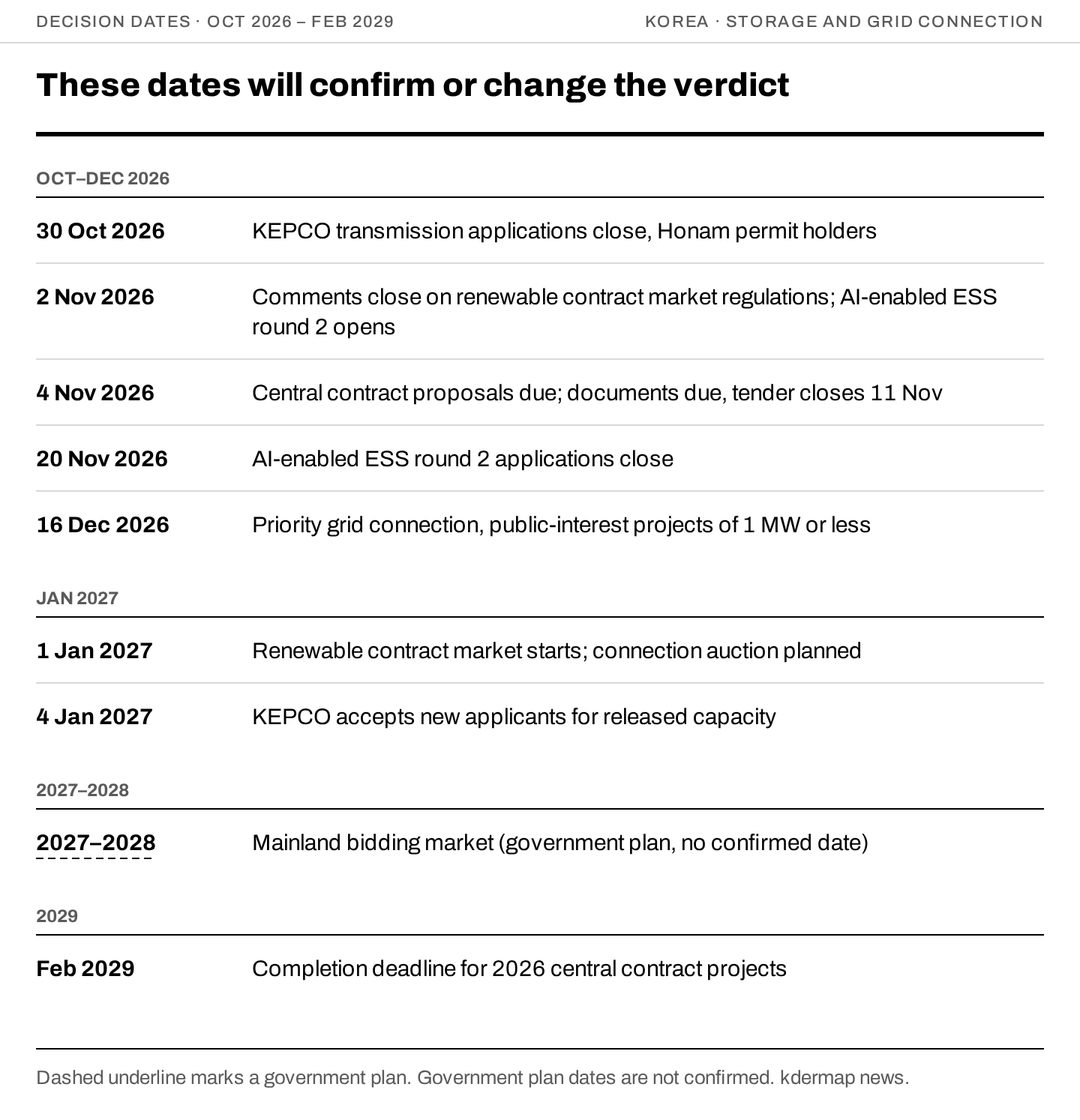
- The central contract market is the only long-term contract until the transmission-side programme is defined. Rounds were held twice in 2025 and once in 2026. Winning one round gives no claim on the next, so a new entrant can still compete. Proposals for the 2026 round are due on 4 November 2026 (18:00). That is too soon to secure a site and prepare a bid, so the realistic entry is the next round, which has not been announced. Its size depends on the 12th Basic Plan, because the rounds so far have used up the 11th plan's volume (our calculation).
- Budget-funded transmission-side storage is not yet an opportunity. It becomes one only when the government decides how it will be procured. Current central contract notices exclude subsidised facilities, so using the auction route would need a rule change.
- Sites are the constraint. Bids must connect to the substations listed in the notice, and the evaluation scores grid contribution. The winner must obtain a generation permit within nine months or lose the award. The transmission grid is constrained, so sites that can connect are limited and need to be secured first. This holds whichever way the government procures its transmission-side programme, because that storage also needs a site on the same grid (our reading). An investor without such a site can enter as capital partner to a developer that has one; the investor's cost of capital then sets the price that wins. Sites must be developed, not just held. KEPCO reviews stalled and speculative projects every year, even after a connection contract is signed.
Distribution grid: pair storage with a VPP operator, starting with government programmes.
- Distribution-grid storage exists to connect more solar, so it comes with a VPP operator. In the AI-enabled ESS programme, a registered VPP operator leads each application, and new solar on selected lines connects through that VPP.
- Government programmes are where distribution-grid storage earns now. The AI-enabled ESS programme pays up to half of eligible capex. The sunshine income village plan would cover 70% of storage cost from national and local funds (not final). Storage in both programmes may charge from the grid, so it earns capacity payments and trading revenue in the wholesale market all year.
- The grid plan makes these positions more valuable. The plan lets more solar connect in saturated areas, but makes each project responsible for controlling its output. Projects on non-firm access are curtailed first, export-limited projects need storage or other means to stay within their limit, and others connect as VPP resources. From January 2027, the plan gives connection rights to projects that win the renewable auction rather than to those that applied first, and stalled projects lose their rights. Connection is moving from queue position to project quality. That favours operators already running storage and VPP control on government lines (our reading).
- Private business will follow market rules. On our reading, the same business expands into private projects once the mainland bidding market (planned for 2027–2028), regional prices (under review) and rules on whether export-limited connection can rest on a contract with grid-connected storage (due in the first half of 2027) are set. Until then, a self-funded battery on the distribution grid earns only from the current wholesale market. Storage that charges only from co-located solar would earn little outside spring (our estimate).
The signal that would bring large-scale investment forward is how transmission-side storage is procured. Its 10 GW is about nine times the 2026 mainland round. If it is procured through private auctions, the volume that lenders can finance rises substantially.
What could change the verdict
Five things could change the verdict. They are the procurement method for transmission-side storage, the storage volume in the 12th Basic Plan, the date of a mainland bidding market, whether export-limited connection can rest on a contract with grid-connected storage, and the final 2027 budget.
- Transmission-side storage. If the 10 GW programme is procured through long-term contracts open to private developers, a second bankable route appears and the central contract market loses its position as the only one. If it is procured without long-term contracts, it adds volume but no new bankable route. The budget proposal does not say which.
- 12th Basic Plan. The 11th plan's central contract volume (2.22 GW to 2029) has already been procured (our calculation). The next plan decides how much is procured from 2030, against a mainland storage requirement the 11th plan put at 4.0 GW in 2030.
- Mainland bidding market. A confirmed date would give uncontracted mainland storage a revenue case. Until then, it has none beyond the current wholesale market.
- Connection by contract with grid-connected storage. Whether storage may charge from the grid is already set by its type: renewable-linked storage charges only from its own plant, while grid-connected storage, as in the AI-enabled ESS and village programmes, charges from the grid. Today, storage-conditional solar connection (KEPCO terms of use, Article 29) counts only storage the solar project installs itself. Rules for export-limited connection are due in the first half of 2027. If they let a solar project connect on the strength of a contract with grid-connected storage, VPP operators can recruit and develop solar themselves, connect it against their own storage and build a private business (our reading). If not, the role stays inside government programmes.
- Final 2027 budget. The budget figures here are a proposal. The National Assembly is due to pass the budget by 2 December 2026.
Smaller factors: capacity recovered from stalled projects may be reallocated to solar rather than storage; performance obligations (cycles, warranted capacity retention) will decide how many central contract projects reach full payment; and the concentration of deadlines in October and November leaves little time between decisions.
Dates
Sources
- Ministry of Trade, Industry and Energy, 11th Basic Plan for Electricity Supply and Demand (2024–2038), revised notice No. 2025-238 (13 March 2025) · 2025-03-13
- Ministry of Climate, Energy and Environment, power grid innovation plan (press release, 29 September 2026) · 2026-09-29
- KEPCO ON, connection applications for capacity released at grid-constrained substations (30 September 2026) · 2026-09-30
- Ministry of Climate, Energy and Environment, AI-enabled ESS support programme, round 2 notice · 2026-09-21
- Ministry of Climate, Energy and Environment, distribution-grid ESS round 1 selection (press release, 10 July 2026) · 2026-07-10
- Korea Power Exchange, 2026 mainland ESS central contract market notice · 2026-09-22
- Korea Power Exchange, 2026 Jeju ESS central contract market notice · 2026-09-22
- Korea Power Exchange, 2026 ESS central contract market bidder briefing · 2026-09-30
- Ministry of Planning and Budget, 2027 budget proposal · 2026-09-01
- Ministry of Climate, Energy and Environment, 2027 budget proposal (press release) · 2026-09-01
- Public hearing materials on the renewable contract market and draft regulations · 2026-09-30
- kdermap news explainer: Korea's renewable contract market · 2026-10-13
- Korea Power Exchange market prices (EPSIS); kdermap news calculation of trading spreads, constrained perfect foresight · 2026-09-30
- Ministry of the Interior and Safety, sunshine income village round 2 selection (press release, 7 October 2026) · 2026-10-07
- Ministry of the Interior and Safety, sunshine income village round 3 notice (No. 2026-1177) · 2026-09-17
- Korea Power Exchange, simulated regional marginal prices, July 2025 to June 2026, v1.0 (6 October 2026; simulated values, not actual prices or a forecast) · 2026-10-06
- Electric Power Journal (Jeonki Shinmun), private coal generators oppose the regional pricing proposal under review by the Rules Revision Committee (7 October 2026) · 2026-10-07
- Government of Korea (joint ministries), implementation plan III for 15 flagship projects (26 November 2025), pp.11 and 17 · 2025-11-26
Related cards
- Korea unveils grid innovation to integrate 100GW+ renewables by 2030
- KEPCO opens applications for released capacity at 164 Honam substations
- Korea announces second round of AI-enabled ESS subsidy for grid-constrained distribution lines
- Korea's largest storage tender to date fixes unindexed 15-year prices